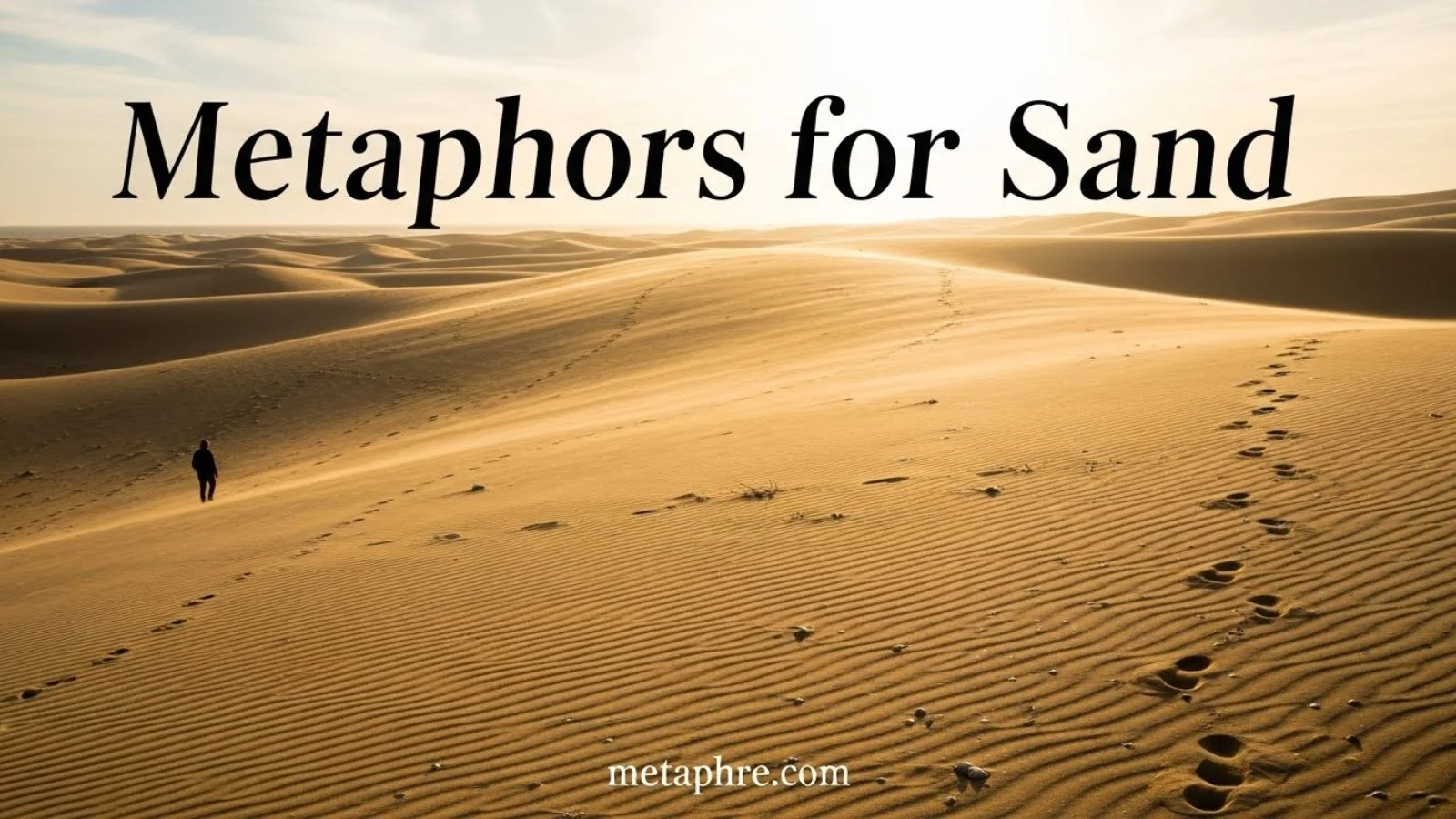
Sand might seem simple or ordinary, but it carries a lot of symbolism—time, impermanence, warmth, and texture.
Using metaphors for sand allows you to turn grains into vivid imagery that evokes emotion and atmosphere.
Instead of just saying “the sand is soft,” these metaphors help your readers feel its qualities, movement, and symbolic depth.
Whether you’re writing poetry, fiction, or descriptive scenes, these comparisons make sand a powerful tool in storytelling.
Metaphors for Sand (With Meaning, Explanation & Examples)
“Sand is nature’s golden carpet.”
Meaning: Sand covers the earth like a luxurious surface.
Explanation: Like a carpet, it spreads evenly and creates texture.
Examples:
- The beach lay like nature’s golden carpet under the sun.
- Tiny shells glimmered on sand, nature’s golden carpet.
“Sand is time slipping through your fingers.”
Meaning: Sand symbolizes impermanence and fleeting moments.
Explanation: Compares individual grains to the passage of time.
Examples:
- Watching the tide, sand slipped through her fingers, time itself.
- Sand falling from the hourglass reminded him that time was slipping away.
“Sand is a desert’s heartbeat.”
Meaning: Sand represents life, rhythm, and continuity in barren landscapes.
Explanation: Suggests the desert is alive through its sand.
Examples:
- Endless dunes of sand marked the desert’s heartbeat.
- The wind shaped patterns in sand, the desert’s silent heartbeat.
“Sand is nature’s golden dust.”
Meaning: Sand glitters and sparkles under sunlight.
Explanation: Highlights the beauty and richness of sand.
Examples:
- Morning sun turned the beach into nature’s golden dust.
- Waves scattered tiny shells across sand, nature’s golden dust.
“Sand is the earth’s soft sigh.”
Meaning: Sand feels gentle and calm under touch.
Explanation: Evokes serenity and softness.
Examples:
- Barefoot, she walked on the sand, the earth’s soft sigh beneath her.
- Sand shifted under the wind, the earth’s soft sigh across the dunes.
“Sand is a shifting sea of gold.”
Meaning: Sand moves and flows like a liquid under wind.
Explanation: Compares sand’s movement to waves or tides.
Examples:
- The desert stretched like a shifting sea of gold.
- Sand rolled over the dunes, a shifting sea of gold.
“Sand is nature’s tiny jewels.”
Meaning: Individual grains glimmer and shine like gems.
Explanation: Highlights sand’s intricate beauty.
Examples:
- Morning dew made each grain of sand sparkle like tiny jewels.
- Shells and sand together created nature’s tiny jewels on the shore.
“Sand is the hourglass of the earth.”
Meaning: Sand symbolizes the passage of time and cycles.
Explanation: Connects sand to human perception of time.
Examples:
- The beach seemed like the hourglass of the earth.
- Watching sand fall reminded him of the hourglass of the earth.
“Sand is a soft, endless ocean.”
Meaning: Sand stretches like waves of a sea.
Explanation: Emphasizes vastness and continuity.
Examples:
- The dunes rolled like a soft, endless ocean.
- Walking across the desert felt like moving over a soft, endless ocean.
“Sand is a golden mirror.”
Meaning: Sand reflects sunlight brilliantly.
Explanation: Compares sand’s reflective quality to a mirror.
Examples:
- The beach became a golden mirror at sunrise.
- Sand reflected the sunset, a golden mirror on the shore.
“Sand is the land’s soft armor.”
Meaning: Sand protects the soil and underlying layers.
Explanation: Acts as a soft barrier and cushion.
Examples:
- The dunes formed sand, the land’s soft armor.
- Every grain of sand was part of the land’s soft armor.
“Sand is the desert’s whisper.”
Meaning: Sand moves silently, shaping landscapes subtly.
Explanation: Evokes quiet motion and subtle beauty.
Examples:
- Wind swept across the dunes, the desert’s whisper.
- Sand shifted like the desert’s whisper under her feet.
“Sand is nature’s flowing ink.”
Meaning: Sand creates patterns and textures like written script.
Explanation: Highlights the artistic, expressive quality of sand.
Examples:
- Waves drew letters in sand, nature’s flowing ink.
- The wind etched patterns in dunes, nature’s flowing ink.
“Sand is a blanket of tiny suns.”
Meaning: Sand glows warmly under sunlight.
Explanation: Creates warmth and radiant imagery.
Examples:
- The beach shone like a blanket of tiny suns.
- Sand sparkled under the midday sun, a blanket of tiny suns.
“Sand is a golden river frozen in time.”
Meaning: Sand moves but feels static in vast landscapes.
Explanation: Evokes the paradox of motion and stillness.
Examples:
- The dunes seemed like a golden river frozen in time.
- Walking across the desert, he marveled at the golden river frozen in time.
“Sand is the earth’s soft pulse.”
Meaning: Sand shows life subtly through wind and movement.
Explanation: Evokes rhythm, subtle motion, and vitality.
Examples:
- The desert moved like the earth’s soft pulse beneath the sun.
- Each ripple of sand felt like the earth’s soft pulse.
“Sand is nature’s golden fabric.”
Meaning: Sand covers vast areas like cloth.
Explanation: Emphasizes texture, spread, and continuity.
Examples:
- The dunes rolled like nature’s golden fabric across the horizon.
- Waves left patterns on sand, nature’s golden fabric underfoot.
“Sand is a fleeting treasure.”
Meaning: Sand represents something temporary and precious.
Explanation: Highlights impermanence and value.
Examples:
- Building a castle in sand reminded him of a fleeting treasure.
- Morning tide swallowed the shore’s sand, a fleeting treasure.
“Sand is the desert’s golden smile.”
Meaning: Sand gives warmth, beauty, and life to barren lands.
Explanation: Personifies sand with warmth and charm.
Examples:
- The sunlit dunes looked like the desert’s golden smile.
- Sand stretched in waves, the desert’s golden smile beneath the sky.
Practical Exercise: Test Your Understanding
Questions:
- Which metaphor shows sand as a reflection?
- Which metaphor emphasizes impermanence and time?
- Which metaphor compares sand to waves or oceans?
- Which metaphor highlights softness underfoot?
- Which metaphor personifies sand as whispering?
- Which metaphor shows sand sparkling like jewels?
- Which metaphor evokes warmth under sunlight?
- Which metaphor depicts sand as a protective layer?
- Which metaphor compares sand to fabric?
- Which metaphor symbolizes fleeting beauty or treasure?
Answers:
- Sand is a golden mirror.
- Sand is time slipping through your fingers.
- Sand is a soft, endless ocean.
- Sand is nature’s golden carpet.
- Sand is the desert’s whisper.
- Sand is nature’s tiny jewels.
- Sand is a blanket of tiny suns.
- Sand is the land’s soft armor.
- Sand is nature’s golden fabric.
- Sand is a fleeting treasure.
FAQs
What are metaphors for sand?
Metaphors for sand are creative comparisons that describe its texture, movement, and symbolism.
Why use metaphors for sand in writing?
They make descriptions vivid, evoke emotion, and convey deeper meanings beyond literal sand.
Can metaphors for sand symbolize time?
Yes, sand often represents the passage of time or impermanence in writing.
Do metaphors for sand only apply to beaches?
No, they can describe deserts, dunes, or symbolic imagery in any landscape.
Final Thoughts
Using metaphors for sand elevates ordinary grains into poetic and meaningful imagery. These metaphors allow writers to convey texture, movement, emotion, and symbolism in ways that simple descriptions cannot.
Whether describing beaches, deserts, or symbolic passages of time, metaphors for sand help bring landscapes and storytelling to life. They turn simple scenery into vivid, memorable experiences for readers.
Read More:
Bring Nature to Life: 165+ Stunning Metaphors for Grass for 2026
145+Stunning Metaphors for Winter You’ll Love in 2026
150+ Metaphors for the Ocean With Meanings and Examples for 2026
Make Words Flow: 50+ Vivid Metaphors for Water for 2026