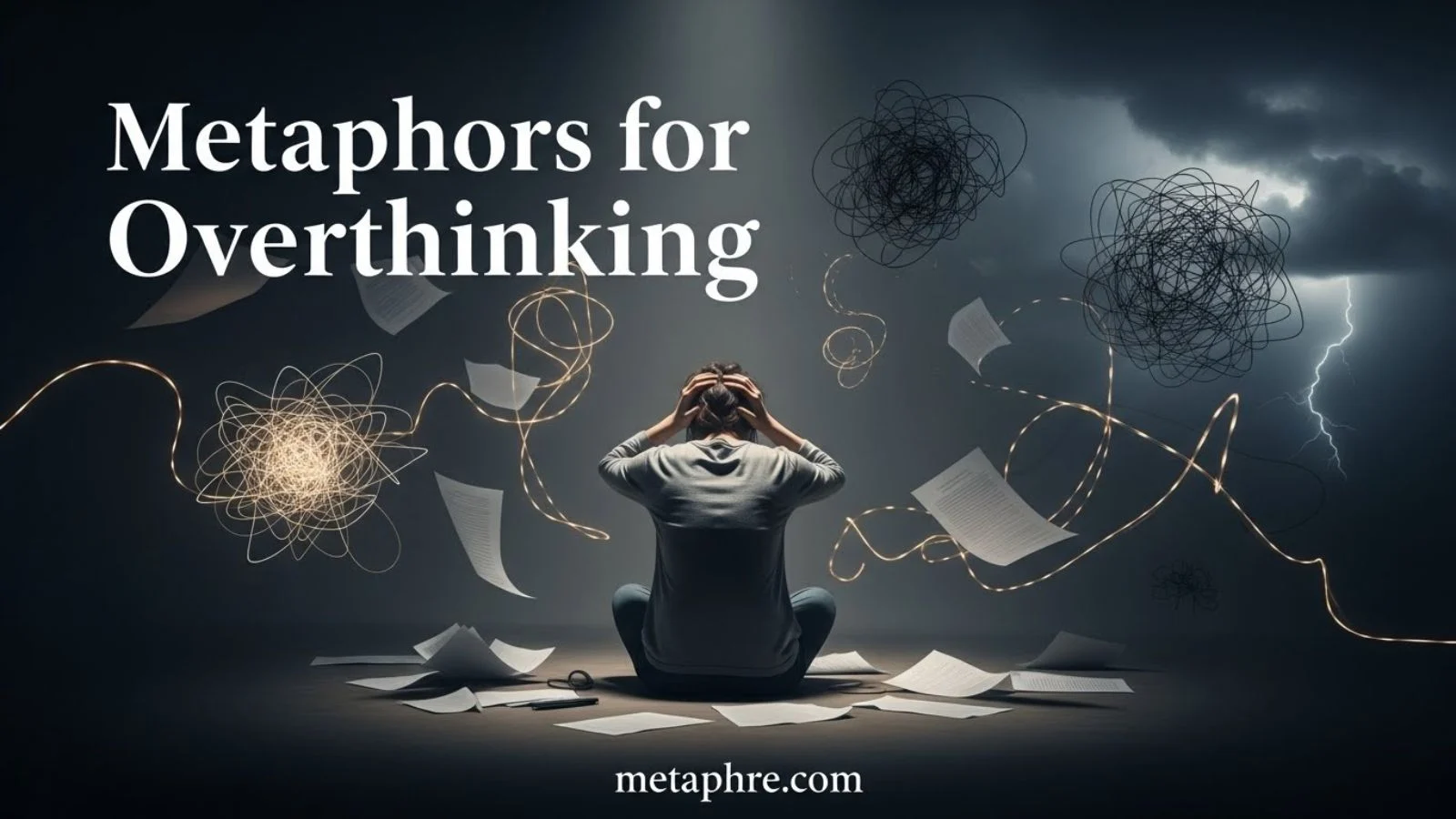
Overthinking can feel like a storm inside your mind, where thoughts swirl endlessly without rest.
Using metaphors for overthinking helps convey this mental chaos in a vivid, relatable way. Instead of simply saying “I can’t stop thinking,” these metaphors allow readers to feel the tension, looping thoughts, and emotional weight.
Whether in personal essays, fiction, or poetry, these comparisons turn abstract mental processes into tangible imagery.
By exploring these 450 metaphors, you can express overthinking in ways that truly resonate.
Metaphors for Overthinking (With Meaning, Explanation & Examples)
“Overthinking is a storm in the mind.”
Meaning: Thoughts are chaotic and overwhelming.
Explanation: Compares mental overload to a violent storm.
Examples:
- Every decision felt impossible, as if overthinking was a storm in my mind.
- Overthinking became a storm in his mind, tossing every thought around.
“Overthinking is a tangled web.”
Meaning: Thoughts become confusing and interconnected.
Explanation: Highlights complexity and difficulty escaping from looping ideas.
Examples:
- She was trapped in a tangled web of overthinking.
- Overthinking spun a tangled web that made decisions nearly impossible.
“Overthinking is a hamster on a wheel.”
Meaning: Thoughts keep running without progress.
Explanation: Suggests repetitive mental activity that leads nowhere.
Examples:
- My mind felt like a hamster on a wheel of overthinking.
- Overthinking turned every minor choice into a hamster on a wheel.
“Overthinking is a dense fog.”
Meaning: Thoughts obscure clarity and understanding.
Explanation: Compares mental confusion to fog limiting vision.
Examples:
- A dense fog of overthinking clouded her judgment.
- Overthinking spread like a dense fog over his decisions.
“Overthinking is a pressure cooker.”
Meaning: Thoughts build up tension until something “explodes.”
Explanation: Highlights mental strain and emotional intensity.
Examples:
- The pressure of overthinking made every problem feel like a pressure cooker.
- Overthinking simmered inside him like a pressure cooker about to blow.
“Overthinking is a tangled ball of yarn.”
Meaning: Thoughts are knotted and difficult to unravel.
Explanation: Suggests confusion and frustration in trying to sort things out.
Examples:
- Her mind was a tangled ball of yarn from overthinking.
- Untangling his ideas felt like working through a tangled ball of yarn.
“Overthinking is a heavy backpack.”
Meaning: Thoughts weigh you down.
Explanation: Conveys mental burden and emotional weight.
Examples:
- Every regret was a rock in the heavy backpack of overthinking.
- Overthinking felt like carrying a heavy backpack everywhere.
“Overthinking is a stormy ocean.”
Meaning: Thoughts are turbulent and unpredictable.
Explanation: Evokes mental unrest and emotional waves.
Examples:
- Her mind was a stormy ocean of overthinking.
- Overthinking tossed his plans like waves in a stormy ocean.
“Overthinking is a spinning top.”
Meaning: Thoughts keep spinning uncontrollably.
Explanation: Suggests rapid, repetitive mental cycles.
Examples:
- Decisions whirled like a spinning top in her overthinking mind.
- His thoughts spun endlessly, like a spinning top.
“Overthinking is a maze with no exit.”
Meaning: Thoughts are confusing and cyclical.
Explanation: Highlights the difficulty of finding clarity.
Examples:
- Overthinking trapped her in a maze with no exit.
- Every solution led to more questions in the maze of overthinking.
“Overthinking is a runaway train.”
Meaning: Thoughts are out of control.
Explanation: Suggests speed, danger, and lack of direction.
Examples:
- Overthinking became a runaway train in his mind.
- Decisions derailed under the weight of a runaway train of thoughts.
“Overthinking is a cloud of gnats.”
Meaning: Thoughts are small but irritating and persistent.
Explanation: Evokes annoyance and constant buzzing in the mind.
Examples:
- A cloud of gnats of overthinking swarmed every decision.
- Overthinking buzzed around his thoughts like a cloud of gnats.
“Overthinking is quicksand.”
Meaning: Thoughts trap and consume you.
Explanation: Suggests difficulty escaping mental loops.
Examples:
- She sank deeper into quicksand with every overthinking thought.
- Overthinking felt like quicksand under his feet.
“Overthinking is a broken record.”
Meaning: Thoughts repeat endlessly.
Explanation: Highlights repetitive, cyclical thinking.
Examples:
- His worries played on a broken record of overthinking.
- Overthinking repeated itself like a broken record in her mind.
“Overthinking is a jungle of ideas.”
Meaning: Thoughts are dense and wild.
Explanation: Suggests difficulty navigating through mental clutter.
Examples:
- She hacked through a jungle of ideas caused by overthinking.
- Overthinking turned every plan into a dense jungle of ideas.
“Overthinking is a storm in a teacup.”
Meaning: Thoughts exaggerate minor problems.
Explanation: Suggests unnecessary mental turmoil.
Examples:
- He made a storm in a teacup through endless overthinking.
- Overthinking turned small issues into a storm in a teacup.
“Overthinking is a tangled garden of weeds.”
Meaning: Thoughts grow wild and uncontrollable.
Explanation: Suggests mental clutter that is difficult to manage.
Examples:
- Her mind was a tangled garden of weeds, overthinking every detail.
- Overthinking turned his simple task into a tangled garden of weeds.
“Overthinking is a constant drizzle.”
Meaning: Thoughts are persistent and nagging.
Explanation: Evokes slow, continuous mental pressure.
Examples:
- A constant drizzle of overthinking dampened her mood.
- Overthinking felt like a constant drizzle in his brain.
“Overthinking is a storm trapped in a jar.”
Meaning: Thoughts are intense but confined internally.
Explanation: Suggests pressure and inability to release mental chaos.
Examples:
- His mind was a storm trapped in a jar of overthinking.
- Overthinking bottled up emotions like a storm in a jar.
Practical Exercise: Test Your Understanding
Questions:
- Which metaphor shows overthinking as chaotic weather?
- Which metaphor emphasizes repetitive mental cycles?
- Which metaphor suggests thoughts are heavy and burdensome?
- Which metaphor shows mental entrapment or loops?
- Which metaphor exaggerates minor problems?
- Which metaphor compares overthinking to persistent small annoyances?
- Which metaphor evokes wild and unmanageable thoughts?
- Which metaphor illustrates rapid, uncontrollable mental motion?
- Which metaphor connects overthinking to impeding decision-making?
- Which metaphor conveys internal intensity without release?
Answers:
- Overthinking is a storm in the mind / stormy ocean.
- Overthinking is a hamster on a wheel / broken record / spinning top.
- Overthinking is a heavy backpack.
- Overthinking is a maze with no exit / quicksand.
- Overthinking is a storm in a teacup.
- Overthinking is a cloud of gnats.
- Overthinking is a jungle of ideas / tangled garden of weeds.
- Overthinking is a runaway train / spinning top.
- Overthinking is a maze with no exit / tangled web.
- Overthinking is a storm trapped in a jar.
Final Thoughts
Using metaphors for overthinking helps transform abstract mental chaos into tangible imagery.
They make the looping, stressful, and heavy nature of thoughts relatable and expressive. By applying these metaphors, writers can illustrate mental overload, anxiety, and indecision in a way that readers feel instead of just read.
Metaphors for overthinking enrich narratives, poetry, and essays by giving form and emotion to complex thought patterns.
Read More:
350+ Metaphors for Curiosity (2026 Edition)
50 Writer-Friendly Metaphors for Ocean Waves with Clear Meanings for 2026
Unlock Emotional Expression with These 60+ Metaphors for Hurt Feelings in 2026
120 Metaphors for Rock: Creative Examples with Meanings for 2026

Michael Chabon is a master of language and a metaphors & similes expert at metaphre.com, where he transforms ordinary words into vivid, unforgettable imagery.
With his creative approach and deep understanding of expressive writing, Michael helps readers unlock the true power of language and craft memorable, impactful writing.