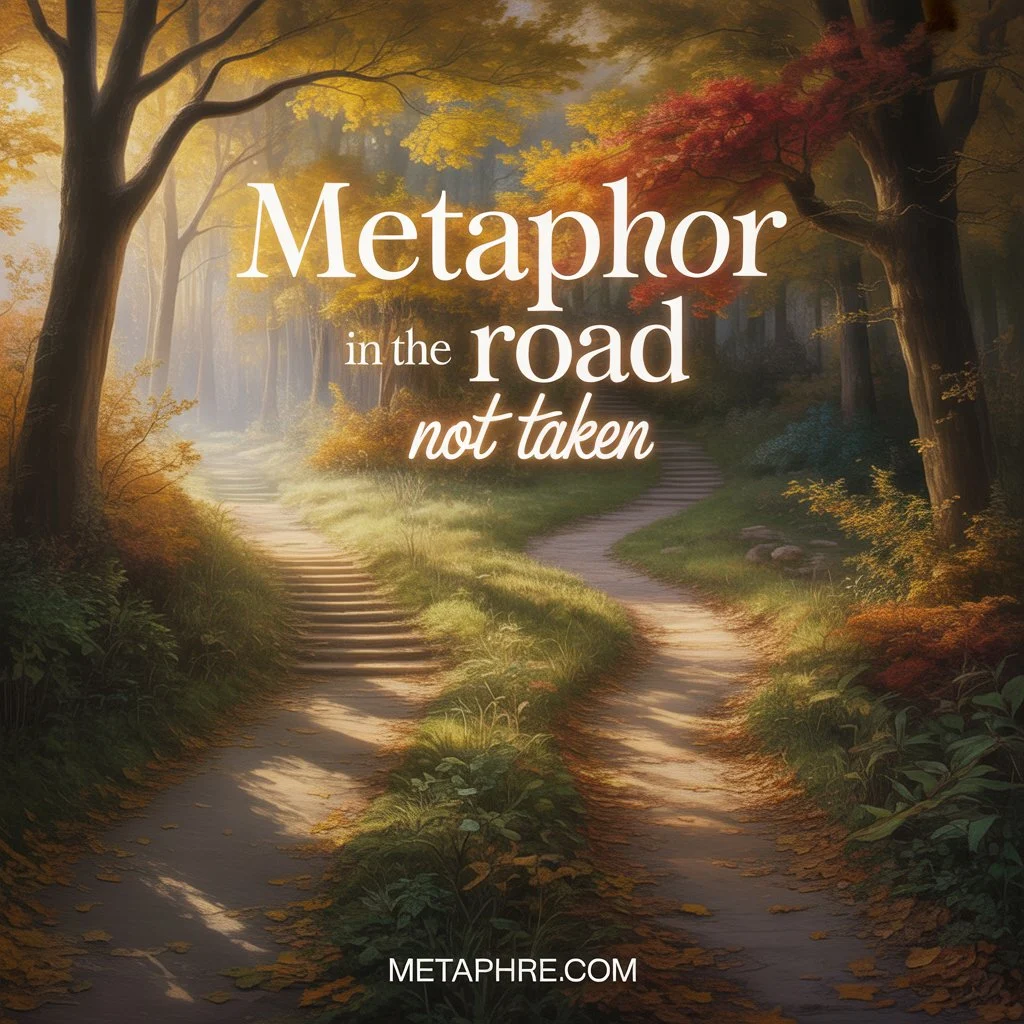
You’ve probably heard Robert Frost’s The Road Not Taken a hundred times—especially that famous line, “Two roads diverged in a yellow wood.” But here’s the thing: it’s not really about roads at all.
It’s about life, decisions, and regret—all wrapped in metaphor. When Frost talks about “roads,” he’s really talking about the paths we choose in life. It’s simple, yet it hits deep because we’ve all stood at that crossroads moment—unsure, hopeful, and maybe even scared.
So, let’s break down the metaphors in The Road Not Taken and see how Frost turned a walk in the woods into one of the most relatable reflections on choice ever written.
The Road as Life’s Journey
Meaning: The road represents the journey of life.
Explanation: Life doesn’t move in straight lines—it twists, forks, and forces us to make choices.
Examples:
- “The road stretched ahead like the years waiting to be lived.”
- “Each step on the road marked another year of my life.”
The Fork in the Road as a Decision Point
Meaning: The fork symbolizes a crucial life choice.
Explanation: Just like two diverging paths, life presents moments where we must choose one direction over another.
Examples:
- “I stood at the fork, knowing one turn could change everything.”
- “His career reached a fork in the road when he had to choose between stability and passion.”
The Traveler as Every Human Being
Meaning: The traveler represents all of us making choices in life.
Explanation: Frost’s “I” stands in for humanity—each of us traveling through life’s uncertainties.
Examples:
- “Every traveler walks a road of decisions.”
- “We’re all travelers, finding our own way through the woods of life.”
The Yellow Wood as Life’s Uncertainty
Meaning: The yellow wood symbolizes a confusing stage of life.
Explanation: The color “yellow” suggests autumn, a time of change and reflection, mirroring uncertainty or maturity.
Examples:
- “The yellow wood reminded me of times when everything felt unclear.”
- “In the yellowing phase of life, every choice seems heavier.”
The Leaves as Opportunities
Meaning: The leaves represent opportunities waiting to be explored.
Explanation: Frost describes leaves untouched by steps—symbolizing choices yet to be taken.
Examples:
- “Fresh leaves covered paths of new possibilities.”
- “He hesitated before stepping on untouched leaves of opportunity.”
The Untrodden Path as the Unconventional Choice
Meaning: The less-traveled road symbolizes unique or risky decisions.
Explanation: It stands for the courage to take a different, nontraditional route in life.
Examples:
- “She took the untrodden path and built a life few dared to imagine.”
- “The less-traveled path led him to self-discovery.”
The Other Road as Conformity
Meaning: The well-trodden path symbolizes following the crowd.
Explanation: Choosing this road means taking the safer, expected choice rather than exploring the unknown.
Examples:
- “He followed the crowded path, where footsteps muffled individuality.”
- “Sometimes the easy road leads nowhere new.”
The Woods as Life’s Complexity
Meaning: The woods represent the confusing, tangled nature of life.
Explanation: Life is filled with uncertainty, just like a dense forest where you can’t see what’s ahead.
Examples:
- “We wander through the woods of decisions and doubts.”
- “The woods whispered of paths unseen and futures untold.”
Morning as New Beginnings
Meaning: Morning symbolizes a fresh start or new phase of life.
Explanation: The light of morning represents clarity and the courage to begin anew.
Examples:
- “Morning broke, and with it came the courage to choose.”
- “Every dawn brings another chance to start over.”
The Traveler’s Sigh as Regret or Reflection
Meaning: The sigh reflects both nostalgia and regret.
Explanation: It’s that emotional breath we take when we look back at what could’ve been.
Examples:
- “He sighed, remembering the road he didn’t take.”
- “Her sigh carried the weight of choices long past.”
The Step as Action
Meaning: The step symbolizes commitment to a choice.
Explanation: Once a person takes a step, they’ve begun walking that chosen path—there’s no turning back.
Examples:
- “Taking that step meant leaving comfort behind.”
- “His first step marked the start of everything new.”
The Grass as Growth and Potential
Meaning: The grass represents growth, freshness, and new beginnings.
Explanation: The greener road may seem more inviting, reflecting life’s potential.
Examples:
- “The greener path promised change and renewal.”
- “He followed where the grass grew thicker—toward new hope.”
The Journey as Self-Discovery
Meaning: The journey stands for personal growth.
Explanation: The act of traveling symbolizes learning more about oneself through choices made.
Examples:
- “The journey taught him who he really was.”
- “Every journey, no matter how short, changes the traveler.”
The Destination as Life’s Outcome
Meaning: The end of the road symbolizes the result of our choices.
Explanation: It reflects where our decisions ultimately lead us.
Examples:
- “She reached a destination shaped by every choice she made.”
- “The destination isn’t as important as how you walk the road.”
The Divergence as Possibility
Meaning: Diverging roads represent different life possibilities.
Explanation: Each path offers its own set of experiences and lessons.
Examples:
- “Two diverging paths, both promising something different.”
- “At every divergence, life asks us to define ourselves.”
The Road Taken as Acceptance
Meaning: The chosen road represents the path we finally accept.
Explanation: It’s about owning our decisions and moving forward without dwelling too much on “what ifs.”
Examples:
- “He found peace on the road he took.”
- “Her chosen path became her story.”
The Road Not Taken as Regret
Meaning: It symbolizes the haunting “what could have been.”
Explanation: It’s human nature to wonder how things might’ve turned out differently.
Examples:
- “The road not taken still echoes in my mind.”
- “He often thought about the road he never walked.”
The Seasons as Life Stages
Meaning: The changing seasons reflect phases of life.
Explanation: Autumn in the poem mirrors maturity or a time of reflection.
Examples:
- “In the autumn of his life, choices felt heavier.”
- “Each season brings its own crossroad.”
The Path Fading into the Undergrowth as the Unknown Future
Meaning: The fading path represents the uncertainty of what lies ahead.
Explanation: We can’t predict outcomes, just like we can’t see where a hidden trail leads.
Examples:
- “The path disappeared, but he walked on in faith.”
- “Beyond the bend lies everything we don’t yet know.”
The Choice as Identity
Meaning: The act of choosing defines who we are.
Explanation: Our identity is shaped not by what we face, but by what we choose to pursue.
Examples:
- “Each choice carved a piece of who she became.”
- “In choosing, we reveal ourselves.”
🧭 Practical Exercise: Test Your Understanding
| Question | Answer |
|---|---|
| What does the road symbolize in the poem? | Life’s journey and the choices we make. |
| What does the “yellow wood” represent? | A stage of life filled with uncertainty or change. |
| What does the “less traveled road” stand for? | Unconventional or unique life choices. |
| What emotion does the traveler’s sigh express? | Regret or reflection. |
| Why is the poem written in first person? | To make the reader personally relate to the experience of choice. |
| What does taking a “step” symbolize? | Commitment to a decision. |
| Why can’t the traveler return to take the other road? | Because once we choose, we can’t relive the same moment. |
| What do the leaves “no step had trodden black” mean? | Opportunities untouched or unexplored. |
| How does Frost use nature as a metaphor? | He uses roads, woods, and leaves to mirror life’s choices. |
| What is the overall theme of the poem? | Life is full of choices, and every path shapes who we become. |
Frequently Asked Questions
What is the main metaphor in The Road Not Taken?
The main metaphor is the “road,” representing life and the choices we make along it.
What is the meaning behind the “two roads diverged”?
It symbolizes life’s decisions—moments where we must choose one direction over another.
Is The Road Not Taken about regret or independence?
It’s both. The poem balances pride in one’s choices with a quiet sense of wonder about the road not taken.
Why is the poem still relevant today?
Because every human faces choices that shape their destiny—just like the traveler in Frost’s poem.
What lesson does the poem teach?
That every decision matters, and our choices—big or small—define who we become.
✅ In a nutshell:
Robert Frost’s The Road Not Taken goes far beyond a simple walk in the woods. It’s a powerful reflection on life, choices, and the paths we dare to follow.
Each road in the poem symbolizes a direction we might take, each filled with its own risks and rewards.
Through the traveler’s eyes, Frost reminds us that every decision shapes who we become. In the end, it’s not just about which road we take—it’s about having the courage to choose and live with that choice.